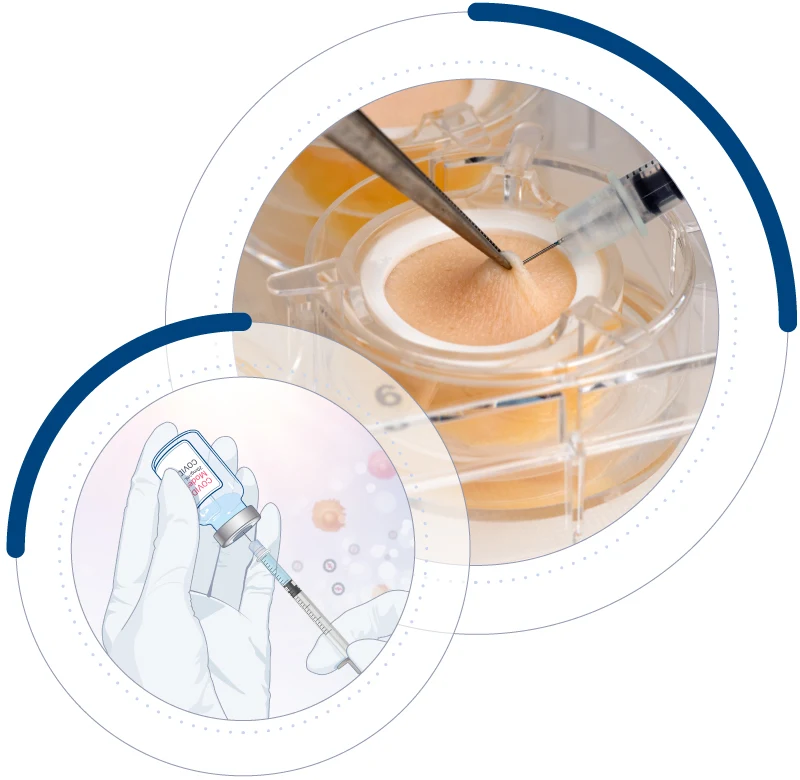
Informed Consent | Confidentiality | Traceability
Ethically Sourced Human Skin for Research
Genoskin develops ex vivo human skin models from residual tissue obtained during routine surgical procedures in France and the United States. This tissue, which would otherwise be discarded, is made available for scientific research only through established clinical partnerships and in accordance with applicable ethical, legal and institutional requirements.
Our sourcing approach is built around the protection of donor rights, confidentiality and human dignity, together with rigorous traceability and quality controls throughout the sample lifecycle. Human biological samples used by Genoskin are obtained only from individuals who have provided prior informed consent for their use in research.
Ethical sourcing at a glance
Consented
Residual surgical tissue is obtained from donors who have provided prior informed consent.
Confidential
Genoskin does not receive information directly identifying donors.
Traceable
Each sample is coded and managed through documented sourcing and quality procedures.
Regulated
Country-specific regulatory and institutional requirements are applied in France and the United States.
No donor payment
Genoskin does not financially compensate donors for human tissue.
Human-relevant
Donated tissue is transformed into controlled ex vivo models supporting human-focused research.
From surgical donation to human skin model

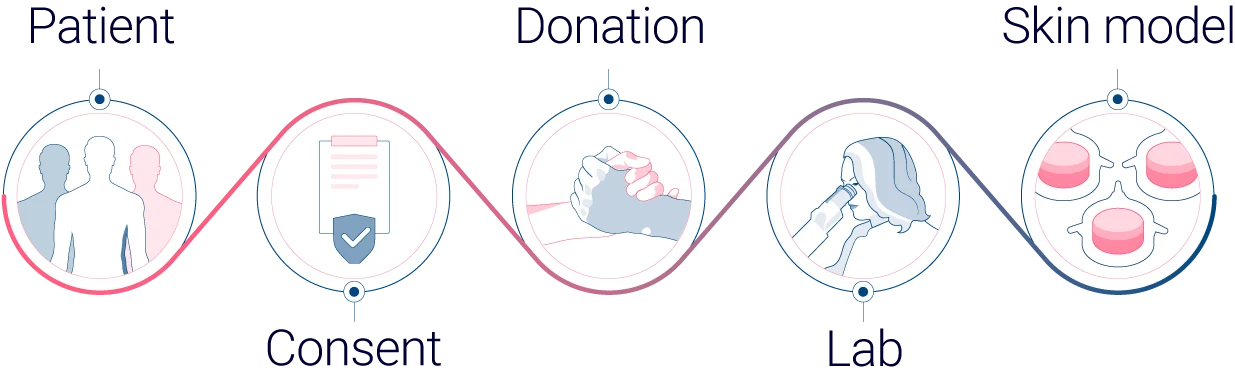
Ethical sourcing continues beyond consent. Genoskin applies documented procedures to preserve sample traceability and quality throughout:
Collection → controlled transport → receipt → processing → model production → quality control → scientific use
Human skin is obtained as residual tissue from routine surgical procedures such as abdominoplasty, brachioplasty and facelifts.
Before a sample is made available for research, the donor is informed of its intended scientific use and provides the required consent. Participation is voluntary and has no impact on the patient’s medical care.
Genoskin works with healthcare institutions under established agreements governing the collection and transfer of biological samples.
Genoskin does not receive information that directly identifies donors. Each sample is assigned a unique internal code, and the link to the donor’s identity remains with the healthcare provider.
We retain only information relevant to scientific use, sample characterization and quality control. Depending on the protocol, this can include age, sex, height and weight, relevant medical conditions, medications or treatments, anatomical site and other scientifically relevant sample characteristics.
This allows biologically meaningful donor variability to be considered without disclosing the donor’s identity.
Genoskin upholds the principle that the human body and its elements must not become a source of financial gain.
Donors receive no financial compensation for providing residual tissue for research.
The fees associated with Genoskin products and services relate to activities such as sourcing coordination, processing, quality control, model production, characterization, logistics and scientific services, rather than to the purchase of human tissue from donors.
Regulatory oversight in France and the United States
Because human tissue sourcing is governed differently in each jurisdiction, Genoskin applies country-specific regulatory and institutional procedures while maintaining the same fundamental ethical principles across its activities.
In France, Genoskin operates within the framework of the French Public Health Code governing the collection, preparation, conservation, transfer and scientific use of human biological samples.
The Genoskin Ethics Policy identifies the following current regulatory authorizations and declarations:
Genoskin also operates according to the applicable requirements for the processing of health research data. The Ethics Policy specifically references the CNIL MR-001 & MR-004 methodologies and external Ethics Committee/CPP review for samples associated with a RIPH2 research project, including validation of the corresponding consent form.
Ethical review in France
France’s Comités de Protection des Personnes (CPPs) provide independent ethical review for research falling within their statutory remit.
Genoskin’s Ethics Policy confirms external Ethics Committee approval in connection with samples associated with Research Involving Human Participants (RIPH2), including review of the applicable consent documentation.
Genoskin’s U.S. sourcing activities operate under applicable federal, state and institutional requirements governing human biological samples and research.
The Ethics Policy specifically identifies:
IRB and protection of human participants
The U.S. Department of Health and Human Services’ regulations at 45 CFR Part 46, commonly known as the Common Rule, establish protections for people participating in covered human-subject research and requirements for Institutional Review Boards.
The regulatory status of research involving biological samples depends in part on whether the samples or associated information are identifiable to the investigator. HHS guidance recognizes that research conducted with appropriately de-identified or coded biospecimens that are not readily identifiable to the researcher may not constitute human-subject research under the Common Rule.
Each U.S. tissue-collection program operates under IRB approval, an exemption determination, or a documented determination that the activity is not human-subject research. Our partner agreements ensure that the information linking samples to donor identity is never released to Genoskin.
Human tissue used exclusively for research
Human tissue supplied for Genoskin’s nonclinical and preclinical research activities is used for scientific purposes and is not intended for transplantation or therapeutic administration to humans. U.S. federal regulations at 21 CFR 1271.15(a) provide an exception from the requirements of Part 1271 for establishments using human cells and tissues solely for nonclinical scientific or educational purposes.
Privacy and health information
Our U.S. clinical partners, as HIPAA-covered entities, share only de-identified or coded information with Genoskin. Genoskin does not receive information directly identifying individual tissue donors.
New York State
Genoskin and its sourcing partners also comply with applicable state-specific requirements for tissue collection.
International ethical principles
In addition to applicable national regulations, Genoskin’s Ethics Policy identifies several international principles and conventions that guide its approach:
Declaration of Helsinki
Genoskin’s ethical approach is aligned with the World Medical Association Declaration of Helsinki – Ethical Principles for Medical Research Involving Human Participants.
First adopted in 1964, the Declaration was most recently revised by the WMA General Assembly in October 2024. It expressly covers medical research involving human participants, including research using identifiable human biological material or data.
Its principles include:
Although the experimental products evaluated using Genoskin models are not administered to the tissue donor, these principles provide an important ethical framework for the responsible sourcing and scientific use of human biological material.
Quality and traceability from donation to research
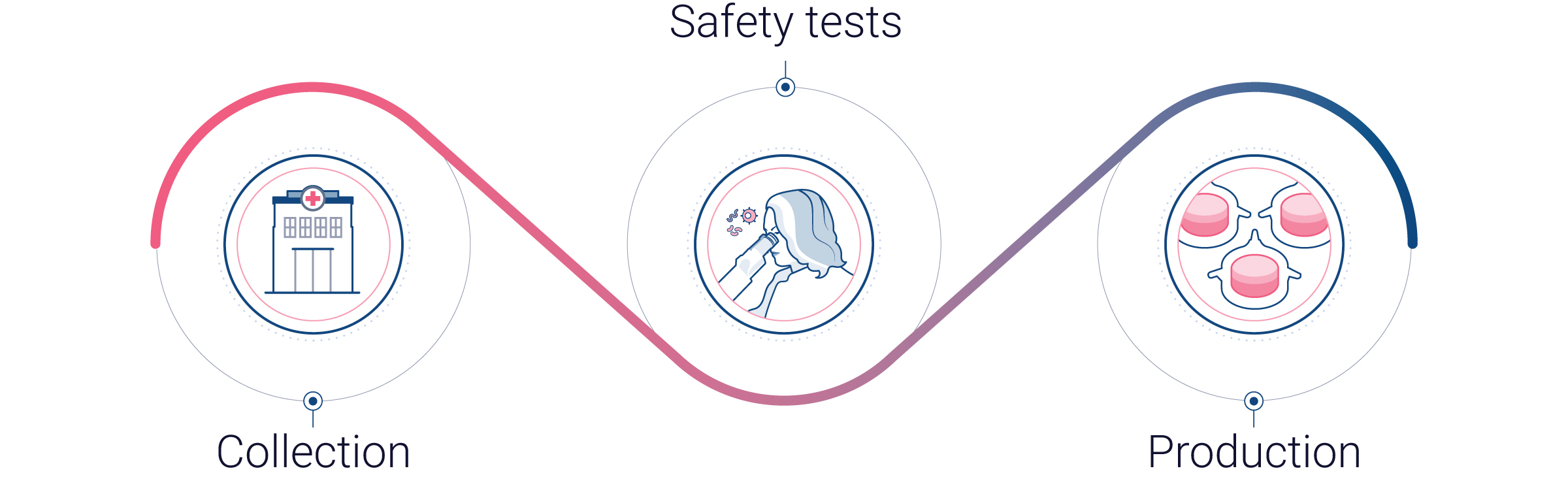
Formal agreements with healthcare partners establish the conditions under which biological material and associated information can be transferred and used.
Unique coding enables sample-level traceability while preventing Genoskin from accessing the identity of the donor.
Biological safety
Human tissue retains the biological characteristics of its donor and must therefore be handled using appropriate biosafety measures.
Samples used to manufacture Genoskin models are evaluated according to defined quality and safety acceptance criteria, including applicable infectious-disease screening and biosafety procedures.

Quality management
Genoskin applies standardized processes for tissue sourcing, receipt, processing, model production and scientific services.
Genoskin SAS operates an ISO 9001-certified quality management system, supporting documented procedures, traceability, quality control and continuous improvement.
This framework complements the ethical and regulatory controls applied to human biological samples.
Supporting human-relevant research
Residual surgical tissue provides an opportunity to generate scientifically valuable human data from material that would otherwise be discarded.
By maintaining human skin ex vivo, Genoskin provides research models that preserve important characteristics of native human tissue and can support applications including:
These human-based approaches can complement or replace animal experiments where scientifically appropriate and contribute to the development and adoption of New Approach Methodologies (NAMs).