
Genoskin & argenx showcase
human-based NAM platform
Press release
Published March 18, 2026
Genoskin presents translational human-based NAM platform at SOT 2026 in collaboration with argenx
At the 2026 annual meeting of the Society Of Toxicology (SOT), we will present new data demonstrating the value of our HypoSkin® ex vivo human skin platform as a translational human-based New Approach Methodology (NAM) for early safety assessment. The poster, developed in collaboration with argenx, will highlight how our platform can support early local tolerance screening and help reduce reliance on animal testing in formulation safety evaluation.
Nicolas Gaudenzio, PhD
Chief Scientific Officer at Genoskin
“The study presented alongside argenx’s immunology specialists clearly shows that HypoSkin® is a valuable human-relevant alternative to in vivo safety testing. Further refinement of the experimental design and techniques could enhance its potential as a reliable alternative for early-stage formulation safety screening, reducing reliance on animal testing.”
Advancing translational human data through collaboration
We are proud to present this work at the Society of Toxicology Annual Meeting 2026, taking place March 22–25 at the San Diego Convention Center.
The study will contribute to the pharmacological validation of our HypoSkin® biostabilized ex vivo human skin platform and demonstrate its potential as a translational, human-relevant testing model.
Through our collaboration with argenx, a global immunology company, we will explore how human skin models can provide more predictive insights into local toxicity and formulation safety earlier in drug development.
A human-based model for injection site & immune response assessment
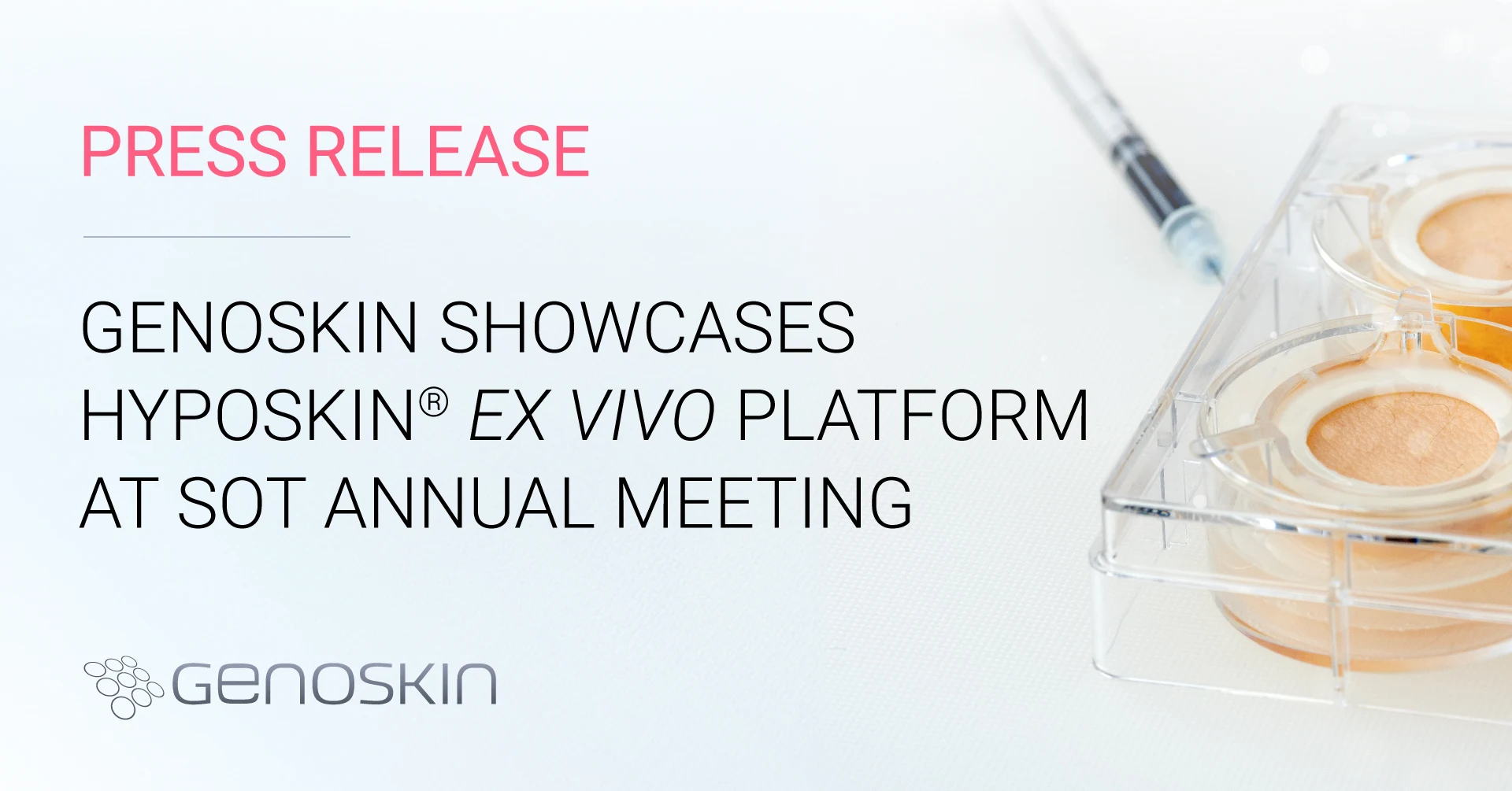
Our HypoSkin® human skin models provide an alternative to directly administering a compound into a patient’s skin. Built on our proprietary biostabilization technology, the platform preserves live, immunocompetent human skin collected after surgery and maintains tissue viability for up to seven days.
This enables drug developers to generate translational human data on injection site reactions and immune responses in a controlled ex vivo setting, helping teams make better decisions earlier in development.
Detecting formulation toxicity with translational endpoints
Despite growing interest in alternative methods, formulation safety testing still relies heavily on in vivo studies due to the lack of validated in vitro models.
The data we will present at SOT show that our HypoSkin® model can successfully detect toxic control formulations, highlighting both its sensitivity and its potential to correlate with in vivo outcomes.
In the study, macroscopic imaging and histopathology capture compound-induced tissue alterations. These endpoints demonstrate strong reproducibility across donors and technical replicates, supporting the model’s potential as a reliable platform for early formulation safety screening.
The abstract (#3267), titled “HypoSkin® as a human-based NAMs platform for local toxicity and formulation safety assessment,” is co-authored by scientists from Genoskin and argenx.
Karen Silence, PhD
Head of Preclinical Product Development at argenx
“Our collaboration with Genoskin reflects our commitment to working with partners who share argenx’s standards for scientific excellence and innovation. Its ex vivo human skin platform delivers high-quality, reproducible data that support informed decision-making in complex immunological settings. We see Genoskin as a trusted partner, combining technical excellence with a deep understanding of immunology.”
Pascal Descargues, PhD
Founder & CEO of Genoskin
“We are proud to be working collaboratively with experts at one of the largest European biotech companies on toxicity assessment of new formulations. We look forward to expanding our capabilities and developing new skin models, based on our European and global clients’ requests. This collaboration reflects the growing demand for predictive, human-based models that enable more informed decisions earlier in development.”
Meeting the growing demand for alternatives to animal testing
The non-clinical testing market is undergoing a major transformation. Demand for alternative testing models is expected to grow significantly in the coming decade, while regulators and industry stakeholders continue to call for the reduction or replacement of animal testing.
At Genoskin, we are addressing this need with scalable, sustainable human-based platforms. By combining our proprietary tissue preservation technology with a robust global tissue sourcing network, we provide live immunocompetent human skin models that remain viable for up to seven days post-surgery.
Backed by a strong intellectual property portfolio and an established service model, our platforms help biopharma, cosmetics, and consumer goods companies generate reliable translational data—particularly for skin-related delivery routes such as injectables, biologics, and topical therapeutics.
Comments are closed.